Mancioni Awaits Laptop Delivery in Prison to Review Murder Evidence
Laptop Delivery Delay for Luigi Mangione in Prison
Case Details and Delivery Delay
The defendant, Luigi Mangione, in the murder case of Brian Thompson, CEO of UnitedHealthcare, is still awaiting the delivery of his laptop in prison. Despite a judge approving the defense's request months ago, the device's delivery has been delayed due to necessary security modifications to prevent any misuse, as well as the enormous volume of evidence that needs to be uploaded. Mangione, currently held at the Federal Detention Center in Brooklyn, faces murder charges in the state case, in addition to a federal case that could lead to the death penalty.
This delay puts significant time pressure on Luigi Mangione ahead of a crucial state case hearing. Defense attorneys have emphasized the importance of him receiving the computer to review more than seven terabytes of evidence, which include video files, documents, and other compiled records and data. To ensure compliance with prison regulations, the laptop has been modified to disable all internet, printer, and wireless network connections.
Prosecution's Stance and Judge's Decision
The Manhattan District Attorney's Office, responsible for the state case, objected to providing Mangione with a laptop, suggesting that his attorneys should present the essential materials to him. However, the judge in the federal case approved the defense's request in August, stipulating that the device must be modified and dedicated solely for reviewing evidence, with daily access hours set from 8 AM to 4 PM.
The defense team is actively seeking to exclude specific evidence collected during Mangione's arrest. This evidence includes a 9mm handgun, a notebook allegedly outlining his intention to "eliminate" an insurance executive, in addition to statements he made to the police.
Crime and Arrest Details
The murder of Brian Thompson, 50, occurred on December 4, 2024, when he arrived at a Manhattan hotel for his company's annual investor conference. Security footage showed a masked gunman shooting him from behind. According to the police, the words "delay," "deny," and "dismiss" were written on the ammunition, indicating phrases often used to describe how insurance companies avoid paying claims.
Mangione, a former software engineer and Ivy League educated, hailing from an affluent Maryland family, was arrested five days after the incident while having breakfast at a McDonald's in Altoona, Pennsylvania, approximately 370 kilometers west of Manhattan.
Legal Developments and Future Outlook
Both cases are currently at a sensitive stage. Last September, Judge Gregory Carro dropped terrorism charges related to the state case, but kept the remaining charges, including manslaughter. A trial date is expected to be set at the next hearing. Regarding the federal case, Mangione's attorneys are demanding that prosecutors be prevented from seeking the death penalty. A crucial federal case hearing is scheduled for January 9.
More than a hundred days after the judge's approval, Luigi Mangione is still awaiting the delivery of his laptop, which is vital for his review of the evidence.
What is a Knowledge Graph?

An illustration on a whiteboard shows an intertwined diagram connecting various icons and concepts, visually representing a network of interconnected knowledge.
“Knowledge Graph” — Source: Pixabay. License: Pixabay License.
A Knowledge Graph is an intelligent database that links information and data in a contextual manner, allowing for the understanding of relationships between different entities and concepts. It can be visualized as a vast network of interconnected facts, where nodes represent entities such as people, places, or things, and edges represent the relationships between these entities. This structure makes it easy for smart systems and humans alike to explore and understand complex information. Knowledge Graphs are fundamental to many artificial intelligence applications, including search engines, recommendation systems, and virtual assistants. For example, Google uses Knowledge Graphs to improve search results and provide more accurate and comprehensive information directly on the results page. They go beyond mere data storage to provide context and meaning, enhancing the ability to infer new knowledge and answer complex queries.
What Is a Knowledge Graph and Why Do You Need One?
Key Components of a Knowledge Graph
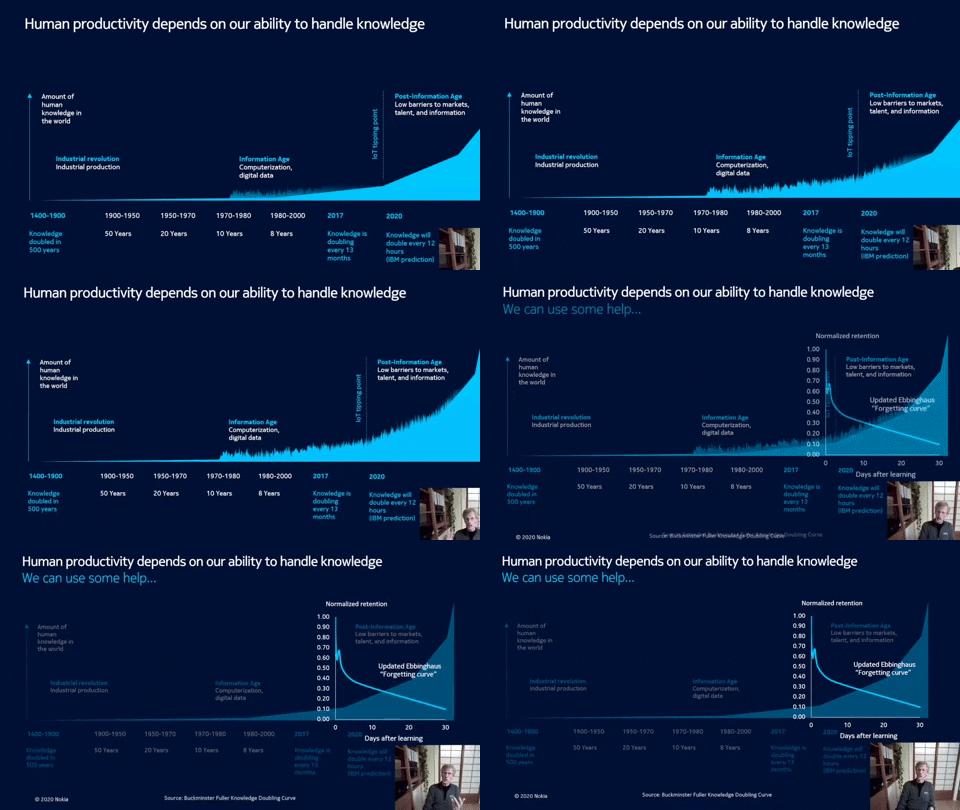
Knowledge Graphs consist of several key components that work together to form a network of interconnected and organized data. These components include:
- Entities: These are the fundamental nodes or points in the knowledge graph, representing real or abstract concepts or things. Entities can be people (e.g., "Ahmed Zewail"), places (e.g., "Cairo"), organizations (e.g., "Google"), events, or even concepts (e.g., "AI"). Each entity has a unique identifier that distinguishes it.
- Relationships/Predicates: These are the links that define how entities are connected to each other. Relationships clarify the meaning between entities and provide context. For example, in the sentence "Ahmed Zewail won the Nobel Prize," "won the prize" is the relationship connecting the entity "Ahmed Zewail" to the entity "Nobel Prize." These relationships allow the graph to understand semantic connections.
- Attributes/Properties: These are the descriptive information associated with entities. Attributes describe an entity and provide additional details about it. For example, the attributes for the entity "Ahmed Zewail" might be "Date of Birth" or "Profession." Each attribute has a name and a value, contributing to the enrichment of information about entities.
- Schema/Ontology: This is the underlying structure that defines the types of entities, relationships, and attributes allowed in the knowledge graph. The schema acts as a model that ensures data consistency and correct semantics. The schema is like the "grammar rules" for the graph, defining how knowledge is organized.
These components help in organizing vast amounts of unstructured and semi-structured data into a comprehensible format that machines can process and utilize.
Knowledge Graph Definition and Guide
Benefits of Using Knowledge Graphs

An abstract image displays a glowing digital graph on a computer screen, symbolizing organized data and interconnected knowledge that form the foundation of knowledge graphs.
“Knowledge Graphs” — Source: Pixabay. License: Pixabay License.
Knowledge Graphs offer a wide range of benefits that enhance how data is organized, understood, and utilized across various fields. Among the most prominent benefits are:
- Improved Information Discovery: By linking data contextually, knowledge graphs facilitate the rapid and effective discovery of relevant information.
- Enhanced Search Accuracy: Knowledge graphs help search engines and query systems better understand user intent, providing more accurate results.
- Artificial Intelligence and Machine Learning: Knowledge graphs serve as a strong foundation for artificial intelligence applications, providing machine learning models with structured and context-rich data.
- Unified Data Management: Knowledge graphs enable the integration of data from diverse sources into a unified and coherent view, resolving the issue of data fragmentation.
- Data Interoperability: Knowledge graphs act as a bridge to connect different data systems, facilitating information exchange and interaction between applications.
- Improved User Experience: By providing structured and contextual information, knowledge graphs can enhance user experience in applications such as virtual assistants.
Overall, Knowledge Graphs work to transform raw data into usable knowledge, supporting innovation and enhancing decision-making.
Knowledge Graphs: A Guide to Benefits and Use Cases
Use Cases of Knowledge Graphs

An illustration on a whiteboard displays a network diagram, visually representing the structure and organization of knowledge graphs and how data is interconnected within them.
“Use Cases of Knowledge Graphs” — Source: Pixabay. License: Pixabay License.
The use cases of knowledge graphs are numerous across various industries and sectors, owing to their unique ability to organize and understand complex and interconnected data. Among the most prominent uses are:
- Search Engines: Knowledge graphs are the backbone of modern search engines like Google, helping to understand relationships and provide more accurate results.
- Recommendation Systems: E-commerce companies and streaming services use knowledge graphs to provide highly personalized product or content recommendations.
- Healthcare and Life Sciences: Used to link medical data from various sources to aid in drug discovery and disease diagnosis.
- Financial Services: Help in fraud detection, risk management, and market behavior analysis by linking financial transactions and entities.
- Customer Relationship Management (CRM): Contribute to building a comprehensive view of customers to provide better customer service and improve marketing strategies.
- Intelligence and Security Analysis: Used to detect links between suspicious entities in combating cybercrime and security threats.
- Government Organizations: Governments leverage knowledge graphs to unify data and improve the delivery of public services.
These examples demonstrate that knowledge graphs are a powerful tool for transforming data into actionable knowledge in a wide range of contexts.
Knowledge Graphs: A Guide to Benefits and Use Cases
Building a Knowledge Graph
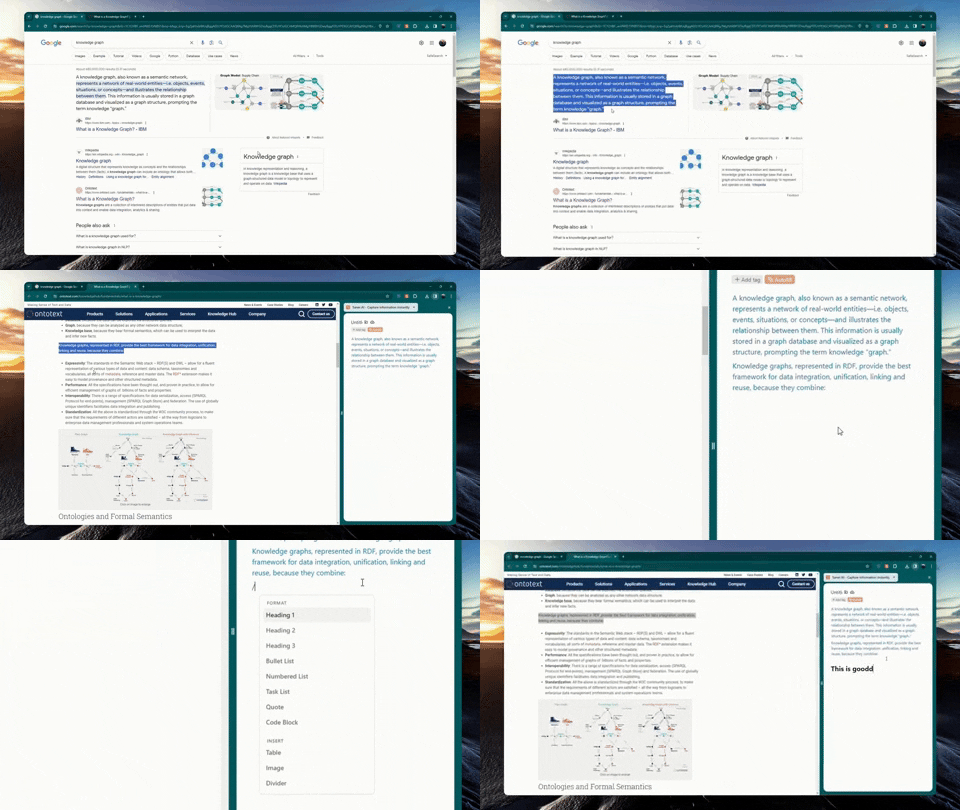
Building an effective knowledge graph requires several steps and methodologies to ensure data is properly organized and usable. The process typically includes the following stages:
- Defining the scope and requirements of the graph: The process begins by identifying the purpose of the knowledge graph and the problems it aims to solve. This includes defining the types of data, key entities, and important relationships.
- Schema Modeling: In this stage, the schema (ontology) that defines the structure of the graph is designed, including entity categories, relationship types, and attributes.
- Data Collection and Extraction: Data is collected from various sources, and information extraction techniques are used to identify entities, relationships, and attributes.
- Data Normalization and Entity Linking: Data is cleaned and standardized, and similar or duplicate entities are linked to create unique identifiers.
- Graph Storage: Knowledge graphs are typically stored in graph databases such as Neo4j or Amazon Neptune.
- Querying and Analysis: Users and systems can query the graph using graph query languages to extract knowledge and discover patterns.
- Maintenance and Updates: Knowledge graphs are not static; they require continuous maintenance and updates to integrate new data and improve quality.
Building a successful knowledge graph requires expertise in data modeling, natural language processing, and data engineering.
Knowledge Graph Definition and Guide
Challenges in Building Knowledge Graphs

A businessman drawing on a whiteboard depicts a network diagram, visually representing the complex process of building and structuring knowledge graphs.
“Challenges in Building Knowledge Graphs” — Source: Pixabay. License: Pixabay License.
Despite the many benefits of knowledge graphs, their construction and maintenance are not without complex challenges. The most prominent of these challenges include:
- Data Quality and Inconsistency: Data from multiple sources is often inconsistent and requires meticulous cleaning and standardization.
- Information Extraction from Unstructured Data: Identifying entities and relationships from free text requires the use of advanced Natural Language Processing (NLP) techniques.
- Complex Schema Modeling: Designing an effective schema that accurately and flexibly represents knowledge is challenging and requires a deep understanding of the domain.
- Entity Linking and Identity Resolution: A significant challenge in identifying similar entities across different sources, requiring sophisticated algorithms.
- Graph Expansion and Maintenance: As data grows, the graph becomes larger and more complex, increasing the difficulty of managing and updating it.
- Scalability and Performance: Handling massive graphs requires robust infrastructure and scalable graph databases.
- Lack of Resources and Expertise: Building knowledge graphs requires specialized skills in data science and knowledge engineering, which can be scarce.
Addressing these challenges requires robust strategies, advanced tools, and a multidisciplinary team.
Knowledge Graph Definition and Guide
Future Trends in Knowledge Graphs

A high-tech abstract image shows a futuristic interface with interconnected circular graphs, symbolizing a complex network of data and information.
“Future Trends in Knowledge Graphs” — Source: Pixabay. License: Pixabay License.
Knowledge graphs are constantly evolving, and there are many future trends that will shape how they are used and developed. Among the most prominent trends are:
- Knowledge Graphs and Generative AI: Knowledge graphs will provide factual and contextual information to enhance the accuracy and reliability of generative artificial intelligence outputs.
- Distributed and Decentralized Knowledge Graphs: The trend will move towards distributed and decentralized models for integrating data from multiple sources, potentially leveraging blockchain technologies.
- Deeper Integration with Machine Learning: The future will see deeper integration between knowledge graphs and machine learning techniques, especially graph learning.
- Knowledge Graphs in Cloud and Edge Computing: They will become a core component in cloud environments and on edge devices, vital for IoT applications.
- Increased Focus on Ethics and Accountability: There will be a greater emphasis on ensuring transparency and fairness in the data and relationships represented by knowledge graphs.
- Knowledge Graph as a Service (KGaaS): More platforms will emerge offering knowledge graphs as a service, making them easier to build and use.
These trends promise to open new horizons for knowledge graphs, making them a more powerful and comprehensive tool in the digital landscape.
Knowledge Graph Definition and Guide

myhome
https://www.aymany.com/

