AWS and Google Cloud Simplify Multi-Cloud Connectivity
AWS Launches Interconnect Service to Address Multi-Cloud Interoperability Challenges
Amazon Web Services (AWS) announced the launch of the innovative "AWS Interconnect - multicloud" service, which aims to overcome the complex challenges of interoperability in multi-cloud environments. This service was unveiled during AWS re:Invent 2025 events and is expected to enhance integration between the AWS platform and various cloud service providers, starting with Google Cloud.
Strategic Partnership Between AWS and Google Cloud to Enhance Cloud Connectivity
Seamless and Robust Multi-Cloud Connectivity
In a significant collaborative move, the two cloud computing giants unveiled new open specifications aimed at achieving interoperability for cloud networks. This initiative leverages the new AWS Interconnect - multicloud service, in addition to Google Cloud's own tool, Cross-Cloud Interconnect. This collaboration aims to provide customers with the ability to establish private, high-bandwidth connections between various cloud providers with greater flexibility and ease than ever before. In the past, connecting workloads across multiple cloud environments required either relying on public connections that lacked bandwidth guarantees or building highly complex private connectivity systems.
The AWS Interconnect - multicloud service offers a fully integrated and managed cloud experience through the use of pre-configured capacity pools. This feature enables organizations to establish cloud connections and adjust their bandwidth with extreme flexibility according to their requirements. AWS manages the entire infrastructure, providing built-in resilience and simplified support that frees customers from the burdens of managing physical hardware or virtual routing objects within their multi-cloud environments.
In this context, Robert Kennedy, Vice President of Network Services at AWS, stated: «This collaboration between AWS and Google Cloud represents a qualitative and fundamental shift in multi-cloud connectivity. By developing and deploying a unified standard that eliminates the complexities associated with any physical components for customers, and simultaneously integrating high levels of availability and security, customers no longer need to exert any arduous effort to establish the required connection. When they need a multi-cloud connection, it will be ready to activate within minutes with a simple click.»

Key Components of Knowledge Graphs

Knowledge Graphs are powerful data structures used to represent interconnected information in an organized and machine-readable way. Knowledge Graphs typically consist of several core components that enable them to effectively achieve their function:
- Entities: These are the nodes in the graph and represent real-world things or concepts such as people, places, organizations, or ideas. For example, "Ibrahim El-Fiki" or "Egypt."
- Relationships: These are the links between entities and describe how they are connected to each other. These links are also known as edges. Example: "Ibrahim El-Fiki was born in Egypt."
- Properties/Attributes: These provide additional information about entities or relationships. For example, the entity "Ibrahim El-Fiki" could have a "Date of Birth" property.
- Ontology/Schema: This is a set of formal definitions for the types of entities, relationships, and properties within a specific domain. Ontology provides a structure and logic for the Knowledge Graph, helping to interpret and understand data consistently.
- Facts: These form combinations of entities, relationships, and properties that represent specific information within the graph, such as (entity: Ibrahim El-Fiki, relationship: born in, entity: Egypt).
These components together contribute to building a semantic network that allows intelligent systems to understand context and infer new information, thereby enhancing their ability to answer complex queries and effectively analyze data. To learn more about this topic, you can visit Ontotext - Knowledge Graph Components and Neptune.ai - Knowledge Graph Tutorial.
Benefits of Using Knowledge Graphs


Knowledge Graphs offer numerous significant benefits for organizations and systems that deal with large volumes of interconnected data, enhancing their analytical and operational capabilities:
- Improved Data Understanding: Knowledge Graphs help unify data from diverse sources and link it semantically, providing a deeper understanding of hidden relationships within the data.
- Knowledge Discovery: They enable the discovery of new patterns and insights by analyzing the links between entities, which can lead to better decision-making and the innovation of new solutions.
- Enhanced Search and Querying: Knowledge Graphs allow for more complex and accurate search and query operations than traditional database systems, as relationships between entities can be queried, not just the entities themselves.
- Data Integration: They facilitate the integration of heterogeneous data from different sources, transforming it into a coherent and interconnected model, solving the problem of data silos.
- Improved AI and Machine Learning: They provide a rich foundation of structured information that can be used to train AI models, improving their accuracy and ability to understand and reason.
- Semantics and Context: They add a semantic layer to data, meaning systems understand not just words, but their meaning and the relationships between them, enhancing the overall contextual understanding of information.
These benefits collectively empower organizations to make the most of their data, transforming it into actionable knowledge that drives innovation and efficiency. For more details, refer to AWS - Knowledge Graph Benefits and GraphDB by Ontotext - Benefits of Knowledge Graphs.
Use Cases for Knowledge Graphs

The use cases for Knowledge Graphs are numerous and diverse, spanning various sectors and industries, demonstrating their flexibility and ability to solve complex problems in diverse contexts. Prominent examples include:
- Search Engines and User Experience Enhancement: Search giants like Google use Knowledge Graphs to deeply understand queries and provide more accurate and relevant results, as well as displaying "knowledge panels" that summarize key information.
- Customer Relationship Management (CRM): They enable building a unified and comprehensive customer view by linking data from different touchpoints, which helps in delivering personalized services and improving customer experience.
- Fraud Detection and Risk Management: Graphs are used to analyze complex patterns of suspicious transactions and relationships, helping to detect fraud and money laundering more effectively.
- Healthcare and Drug Discovery: They help link patient data, medical records, genetic research, and drug properties, supporting diagnosis, personalized treatment, and accelerating the drug discovery process.
- Recommendation Systems: Used to build accurate profiles of users and items (such as products, movies, articles), and then recommend relevant items based on discovered relationships.
- Explainable AI (XAI): They contribute to making AI model decisions more transparent and understandable by providing context and information about how certain conclusions were reached.
These examples highlight the positive impact of Knowledge Graphs in transforming how data is processed and utilized in today's digital world. More use cases can be explored by visiting IBM Research - Knowledge Graph Use Cases and Databricks - What is a Knowledge Graph?.
Building a Knowledge Graph
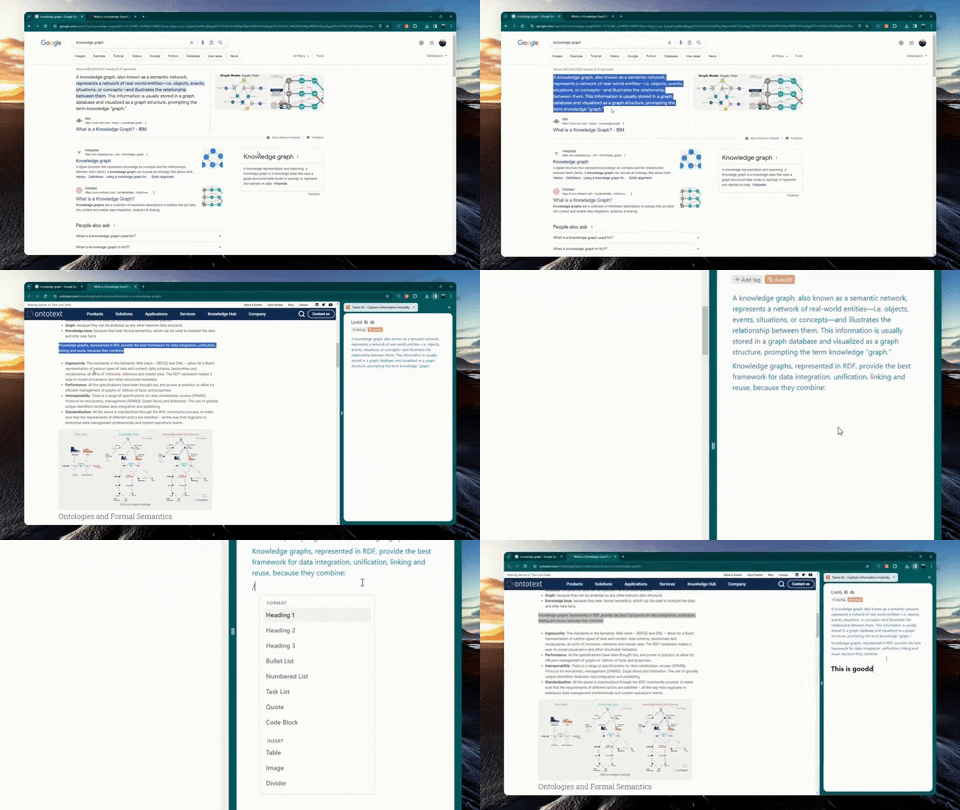
Building a Knowledge Graph involves several essential steps that require careful planning and data processing to ensure its effectiveness and accuracy. Here are the main steps:
- Define Scope and Objectives: Before starting, it is crucial to define the problem the Knowledge Graph will address and its desired objectives, as well as to determine the scope of the data to be included.
- Identify and Collect Data Sources: Data is collected from various sources such as relational databases, text documents, APIs, and semi-structured data.
- Information Extraction: This step involves extracting entities, relationships, and properties from raw data using techniques like Natural Language Processing (NLP) and Machine Learning (ML).
- Ontology Modeling: An ontology is designed or selected that defines the types of entities, relationships, and attributes, providing a semantic structure for the graph. This step is crucial for organizing knowledge.
- Graph Storage: The extracted and modeled data is stored in a Graph Database such as Neo4j or Amazon Neptune, which are ideal for representing and managing complex relationships.
- Data Integration and Transformation: At this stage, data from different sources is integrated into the graph, with redundancy and conflicts addressed to ensure data consistency.
- Graph Validation and Refinement: After initial construction, the quality and accuracy of the graph must be validated, and any necessary improvements made to ensure it meets the defined objectives.
Building a successful Knowledge Graph requires iteration and continuous monitoring, as the graph can be expanded and updated as needs evolve and more data becomes available. For detailed guidance, you can visit IBM Cloud Blog - How to Build a Knowledge Graph and Towards Data Science - How to Build a Knowledge Graph From Scratch.
Challenges in Building Knowledge Graphs

Despite the many benefits offered by Knowledge Graphs, the process of building and maintaining them is not without complex challenges that must be addressed. Prominent among these challenges are:
- Data Quality and Inconsistency: Raw data is often unclean, contains errors, redundancies, or inconsistencies in format, making the extraction and integration process into the graph difficult.
- Semantic Complexity: Ontology modeling and defining semantic relationships require a deep understanding of the knowledge domain and expertise in knowledge engineering, which can be challenging and time-consuming.
- Scalability: As data volume and relationship complexity grow, maintaining graph performance and responsiveness becomes a significant challenge, especially when dealing with billions of entities and relationships.
- Integration from Multiple Data Sources: Integrating data from different sources with varying structures and formats requires significant effort in data processing and standardization.
- Graph Maintenance and Updates: Not only is the construction process a challenge, but continuously updating the graph and adding new information or modifying relationships requires effective mechanisms and dedicated resources.
- Lack of Standardized Standards: Despite the existence of some standards, there is still a lack of unified industry standards for creating and exchanging Knowledge Graphs, which can lead to interoperability difficulties.
Addressing these challenges requires robust data management strategies, advanced information extraction tools, expertise in ontology design, and a strong infrastructure to support scalability. These challenges can be explored further by visiting DATAVERSITY - Challenges of Building a Knowledge Graph and Medium - Challenges and Opportunities in Building Knowledge Graphs.

myhome
https://www.aymany.com/

